CRA reporting duty: 24 hours, from the moment you know
Article 14 of the Cyber Resilience Act has applied since 11 September 2026 — including to machines already in the field. Which deadlines run, and what you need to answer them.
Choose hardware freely, deploy applications more easily, run machines reliably: what matters when moving to cloud-native automation, and how IDE, CONTROL, ORCHESTRATE and DELEGATE work together.
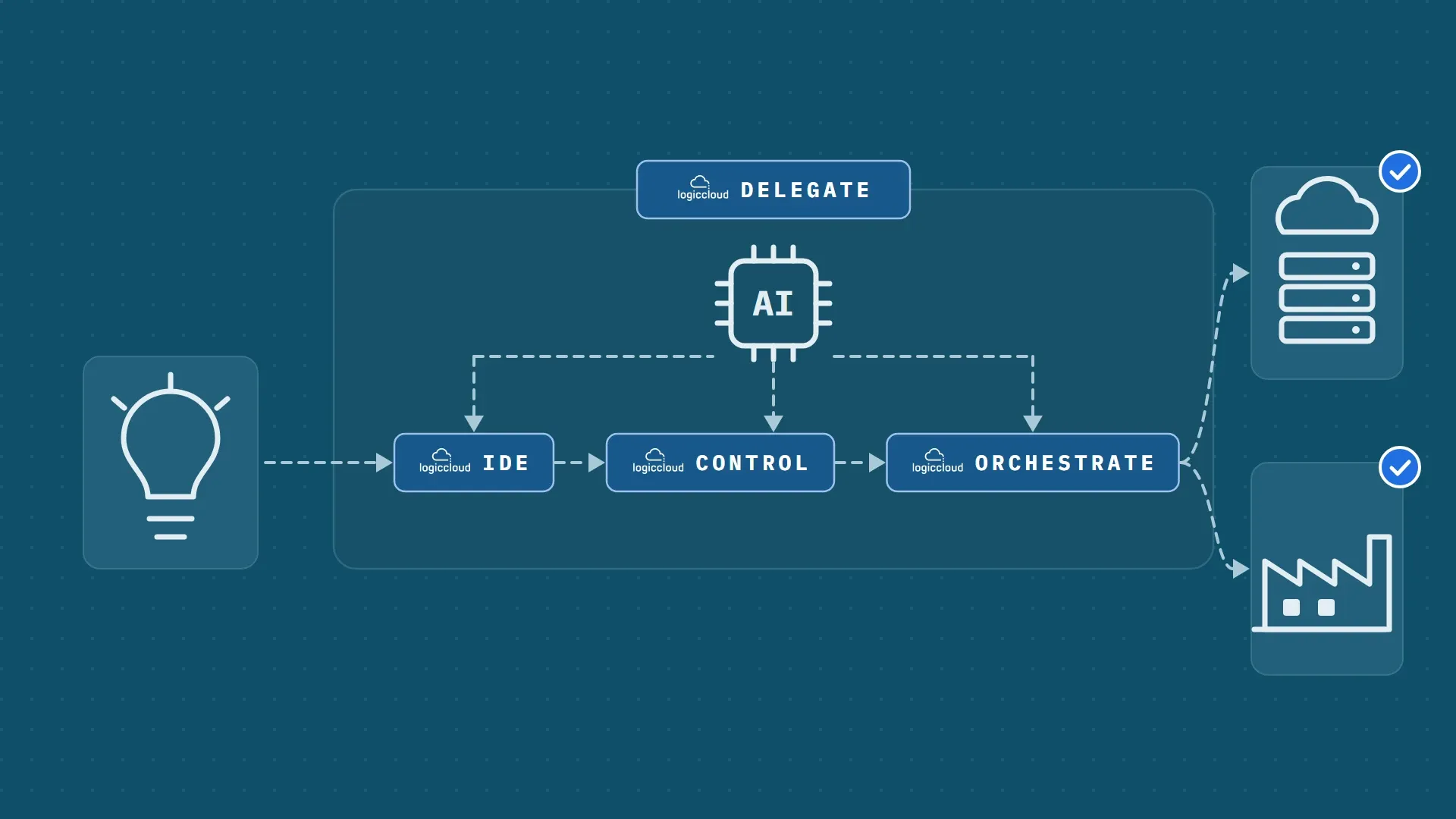
Choose hardware freely, deploy applications more easily and run machines reliably for years: cloud-native automation opens up new possibilities. For users, though, the move starts with concrete questions: How do processes stay reliable? How can existing plants be integrated? And how does new technology actually turn into less effort?
Companies have to adapt machines to new requirements faster, look after more systems with limited resources and keep software up to date across long plant lifecycles. At the same time, data processing and AI directly in the industrial environment are gaining importance. That increases the need for automation that is easier to extend, distribute and maintain.
Engineering and service teams have to handle more and more tasks with limited staff. Device-specific installations, repeated configurations and manual updates tie up time.
Cloud-native approaches lay the foundation for reusing applications and automating deployment and operation to a greater extent. The benefit grows especially when many comparable systems are looked after.
Tight links between control software and hardware make it harder to switch to other devices. Product discontinuations or changed performance requirements can therefore trigger costly adaptations.
Software-defined automation loosens this link. Applications can be used on different suitable platforms. That widens the room for manoeuvre in purchasing and further development.
New product variants, changed processes and additional customer requirements often call for software changes. Companies want to add functions without rebuilding the whole automation every time.
Modular applications and standardised deployment processes make it easier to test changes and distribute approved versions to the intended systems in a targeted way.
Alongside classic control, applications for image processing, quality control, energy optimisation, IoT and AI are needed.
These functions have to work together on suitable hardware and be looked after across their lifecycle. Containers and shared application management lay the foundation for this – including for software from different vendors.
Connected machines need long-term software maintenance. Companies need to know which versions are in use, who may access systems and how changes can be traced.
Central software management, controlled approvals and documented updates are therefore gaining importance. Cloud-native operating models can help organise these processes consistently across many systems.
Machine builders want to look after delivered plants more efficiently and offer additional functions through software. Operators want to fix faults faster and reduce site visits.
Remote access, a central status overview and targeted software distribution support such offerings. The ability to run software reliably thus becomes an important part of machine and plant service.
Cloud-native automation can significantly reduce engineering effort, hardware costs and ongoing service costs. Investments pay off faster and the return on investment rises. What matters is an architecture that fits the application and one continuous process from development to operation.
Industrial automation has to work day to day – during network interruptions, after a software update and across long plant lifecycles. New software architectures have to measure up to these requirements.
Which control functions have to run directly at the machine, and which can be moved to central infrastructure? What matters is the response time of the whole system: from capturing a sensor signal through processing to the output at the actuator.
A short PLC cycle time alone is not enough for this assessment. Communication, I/O processing and timing variations have to be taken into account too. It also has to be clear how the plant behaves when connections drop or individual components fail.
In practice, new applications meet existing PLCs, fieldbuses, sensors and actuators. Different interfaces and vendor-specific tools make integration laborious.
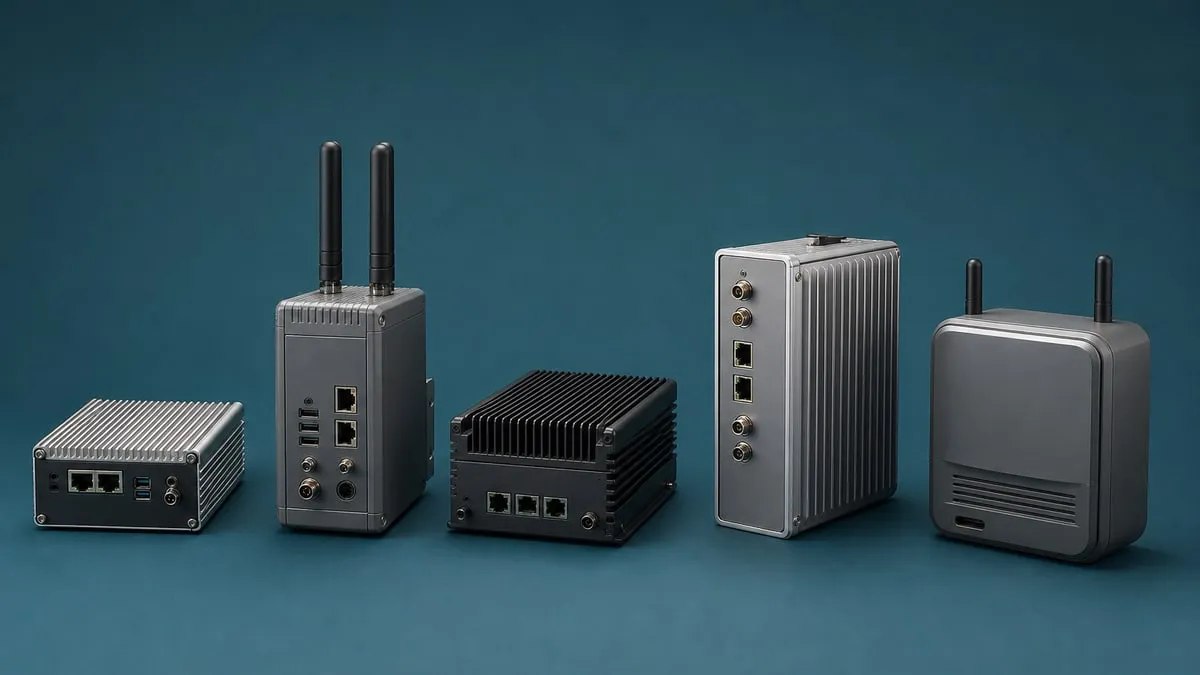
A container does not automatically run on every device either. Processor architecture, operating system, drivers and available resources have to fit the application. Users therefore need an architecture that allows hardware freedom and takes the requirements of the process connection into account.
Long-term operation begins with the first commissioning. Applications have to be updated, bugs fixed and security gaps closed – often on many devices with different software versions.
That calls for tested versions, clear approvals and suitable maintenance windows. Restoring a working state has to be prepared as well. For control applications, process states and stored data have to be considered alongside the software.
Who may change an application? Who approves an update? And which service technician may access which machine?
With growing connectivity, permissions, device identities and remote access have to be managed systematically. At the same time, IT and automation need shared processes and clear responsibilities for infrastructure, applications and troubleshooting.
Less special control hardware does not automatically mean lower total costs. Integration, training, platform operation and long-term support are part of the calculation too.
The benefit comes when applications can be reused, fewer manual hand-overs are needed and delivered systems can be looked after with less effort.
The central question is therefore: How do companies gain hardware freedom and simpler software maintenance without burdening their plant operation with extra complexity?
logiccloud’s answer is one continuous process – from development through execution to deployment and ongoing operation.
Cloud-native describes how software is built, deployed and operated. Applications are packaged as containers, connected through defined interfaces, and distributed, updated and monitored with suitable tools.
A permanent connection to a public cloud is not fundamentally required for this. Cloud-native principles can also be used directly at the machine or within your own infrastructure.
For industrial automation this means: the application can be decoupled more from a specific control hardware. Where it runs is decided by the requirements of the process.
Time-critical functions run directly at the machine. Applications whose requirements allow it can run on central infrastructure in the data centre. That way local process proximity and central IT resources can be used within one architecture.
The logiccloud IDE is the development environment for PLC programs, web HMI and process connection. Development happens in the browser – without installing a classic engineering environment locally.
Control programs are written in IEC 61131-3 Structured Text. Visualisation and communication interfaces complete the application. Simulation and tests make it possible to check functions before they are used on the target hardware.
That makes collaboration easier and reduces tool switching and manual hand-overs between development, commissioning and service. Reusable building blocks help use proven functions in further projects.
logiccloud CONTROL is the all-in-one Automation App: a virtual PLC to IEC 61131-3, web HMI and communication interfaces in one container.
Control logic, operator interface and connectivity are thus deployed as one application that belongs together. Depending on the requirements, CONTROL runs directly on a suitable edge device or as a cloud-native workload in the data centre.
For machine builders and operators this means more freedom in choosing hardware. The automation software remains the foundation, while the right execution platform can be chosen by performance, availability and cost.
CONTROL Edge runs directly on the device and accesses local I/O as well as connected sensors and actuators. Ongoing control operation is independent of an internet connection.
With soft real-time at a 3 ms cycle time, CONTROL Edge is suited to corresponding time-critical automation tasks. Which cycle times can be reached reliably under the actual operating conditions depends on the hardware, the operating system and the application, and is checked during design. The whole response time from sensor to actuator is considered as well.
Typical fields of use are machines, plants, buildings, and energy and infrastructure systems.
CONTROL Cloud runs the Automation App as a cloud-native workload in the data centre. The virtual PLC runs on central infrastructure, for example in a Kubernetes environment.
The connection to the physical process is made through a local process connection. It captures signals from sensors and passes setpoints to actuators. The control logic runs centrally.
Whether an application is suitable for this is decided by the timing the whole communication path requires. Network delays, variations and the availability of the connection have to fit the task. How the system behaves when the connection drops is also defined during design.
For suitable applications this architecture can reduce the need for powerful control hardware on site. Computing power is used centrally, applications can be deployed centrally and additional instances added as needed.
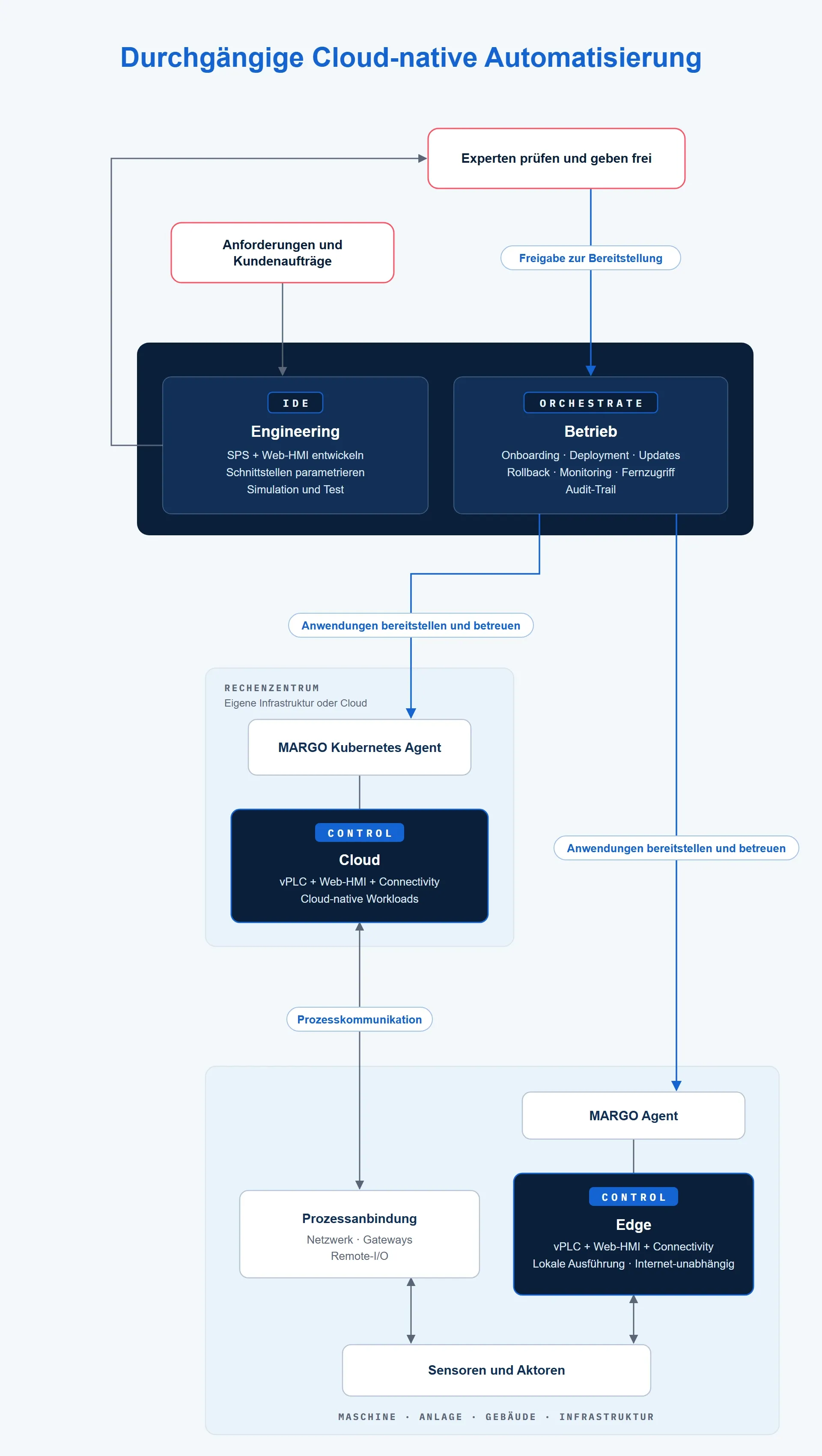
An application’s lifecycle begins once it has been developed. It then has to reach the intended systems, be kept up to date and be monitored in operation.
logiccloud ORCHESTRATE supports this process: from secure onboarding through deployment to updates, rollbacks and monitoring of the system state.
Instead of looking after every device individually, service teams can manage software versions centrally and distribute approved changes remotely. Tests, approvals and suitable maintenance windows remain part of the operating process.
That cuts recurring manual steps and makes it easier to look after more delivered systems with the existing team.
logiccloud ORCHESTRATE uses the MARGO standard to support the deployment and management of applications in a heterogeneous edge ecosystem.
ORCHESTRATE is not limited to logiccloud CONTROL. Compatible apps from other vendors and in-house applications can be deployed and managed too – for example for:
This creates a shared operating foundation for different industrial applications. Companies can align their choice of software with the task at hand and run applications within one shared management process.
MARGO supports standardised interplay between applications, edge devices and orchestration software. Whether a specific application can be used on a particular device still depends on its technical requirements and the available interfaces.
ORCHESTRATE enables secure access to the device’s web interface without having to set up a separate VPN connection.
Service teams can thus access a system faster, check settings and investigate faults. Granular user management defines who may access which systems and functions.
An audit trail documents changes and supports traceability in operation. That makes service hand-overs easier and helps compile evidence for security and compliance processes.
logiccloud DELEGATE adds AI agents to the process that prepare and work on automation tasks.
From a task description, agents can develop PLC programs, HMI and interface configurations and run tests. Recurring work steps can be sped up this way and results prepared for expert review.
The experts make the decisions: they check how the application behaves, assess the results and approve changes for use.
So the technical responsibility stays with the automation team, while AI agents support the implementation.
The building blocks interlock along the lifecycle:
For companies this means less tool switching, fewer manual hand-overs and a more consistent way of handling applications – from first development to the update in the field.
Software-defined automation lays the foundation for developing automation further, beyond the lifecycle of a single hardware platform.
With logiccloud, companies can run applications on suitable hardware, add further functions and look after delivered systems centrally. Local control and central execution are used to suit the task.
The concrete benefit: more freedom in buying hardware, less effort for deployment and service, and more traceable changes during operation.
What advantages does cloud-native automation offer for your plants? Which existing components can you keep using? And how do you make the move while operation continues?
In a consulting workshop with logiccloud experts, we look at your starting point, your requirements and your goals together with you. We bring together the perspectives of automation, IT and service and develop a concrete approach for your project.
Together we discuss:
The result is a decision basis worked out together: with a suitable use case, a first target architecture and concrete next steps. That way you can assess benefit and effort before you invest in implementation.
Plan your start in cloud-native automation. Describe your project to us and arrange a workshop with our experts.
Article 14 of the Cyber Resilience Act has applied since 11 September 2026 — including to machines already in the field. Which deadlines run, and what you need to answer them.
Preview Release 3 is out and the first general release is expected in 2027. What the open edge standard changes in practice — and what you can do today.
BSI registration was due on 6 March, the extension on 31 July. Both are gone — the obligation is not. What to do now, in the order that actually works.